|
IRIG 106-99 CHAPTER 6 - MAGNETIC TAPE RECORDER AND REPRODUCER STANDARDS, Continued.... 6.1 Introduction 6.2 Definitions 6.3 General Consideration for Longitudinal Recording 6.4 Recorded Tape Format 6.5 Head and Head Segment Mechanical Parameters 6.6 Head Polarity 6.7 Magnetic Tape and Reel Characteristics 6.8 Direct Record and Reproduce Systems 6.9 Timing, Predetection, and Tape Signature Recording 6.10 FM Record Systems 6.11 PCM Recording 6.12 Preamble Recording for Automatic or Manual Recorder Alignment 6.13 19-mm Digital Cassette Helical Scan Recording Standards 6.14 Multiplex/Demultiplex (MUX/DEMUX) Standard for Multiple Data Channel Recording on 19-MM Digital Cassette Helical Scan Recorder/Reproducer Systems 6.15 Submultiplex/Demultiplex Standards for Multiple Data Channels on a Primary Digital Multiplex/Demultiplex Channel 6.16 1/2 Inch Digital Cassette (S-VHS) Helical Scan Recording Standards 6.17 Multiplex/Demultiplex (MUX/DEMUX) Standards for Multiple Data Channel Recording on ˝ Inch Digital Cassette (S-VHS) Helical Scan Recorder/Reproducer Systems MAGNETIC TAPE RECORDER AND REPRODUCER STANDARDS Continued....  6.17 Multiplex/Demultiplex (MUX/DEMUX) Standards
for Multiple Data Channel Recording on ˝ Inch Digital Cassette (S-VHS) Helical
Scan Recorder/Reproducer Systems.
6.17 Multiplex/Demultiplex (MUX/DEMUX) Standards
for Multiple Data Channel Recording on ˝ Inch Digital Cassette (S-VHS) Helical
Scan Recorder/Reproducer Systems.6.17.1 General 6.17.2 Setup Block Format 6.17.3 Multiplexer Format 6.17.3.1 Frame Structure 6.17.3.2 Pacer Divisor Calculation 6.17.3.3 ARMOR Channel Coding 6.17.3.4 Sync Pattern 6.17.3.5 Time Code Channels 6.17.3.6 PCM Channels 6.17.3.7 Analog Channels 6.17.3.8 Parallel Channels 6.17.4 ARMOR Format Compatibility 6.17.5 ARMOR Format Validation For recording and reproducing multiple channels on 1/2 Inch Digital Cassette (S-VHS) Helical Scan Recorders, the Asynchronous Real-time Multiplexer and Output Reconstructor (ARMOR) multiplex/demultiplex format is recommended. The ARMOR data format is an encoding scheme that may be used to multiplex multiple asynchronous telemetry data channels into a single composite channel for digital recording, transmission, and subsequent demultiplexing into the original constituent channels.
6.17.1 General. Data types supported by the
ARMOR format are PCM, analog, decoded IRIG time, and 8-bit parallel. MIL-STD-1553
data is encoded into an IRIG 106 Chapter 8 serial PCM stream prior to multiplexing
into the ARMOR format. Voice channels are encoded in the same way as all other
analog channels. The composite channel is formatted into fixed bit-length,
variable word-length frames. A constant aggregate bit rate and a fixed frame
bit-length are established for each multiplex by an algorithm that is dependent
on the number, type, and rate of the input channels. The aggregate bit rate and
frame bit length result in a fixed frame rate for each multiplex. The ARMOR
encoding scheme captures the phase of each input channel relative to the start of
each composite frame. The demultiplexing process may then use the captured phase
information to align the reconstruction of the constituent channels relative to a
reproduced constant frame rate.
6.17.2 Setup Block Format. In addition to
defining the organization of the frames containing the multiplexed data, the
ARMOR format incorporates the definition of a “setup block” that contains the
parameters necessary to demultiplex the associated data frames. The setup block
is included in the composite stream at the start of each recording to preserve
with the data the information necessary to decode the data.
Appendix L defines the setup block format and
content.
6.17.3 Multiplexer Format. The definition of
the ARMOR multiplex format has two parts. The frame structure definition
describes the organization of the composite data frame which changes from one
multiplex to the next. The channel coding definition describes the encoded data
word format for each data type, which is the same for all multiplexers.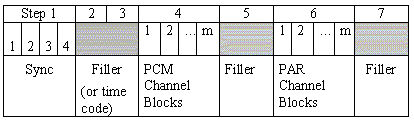 6.17.3.1 Frame Structure. The sequence of
steps used to establish the multiplexed frame structure, shown in
Figure 6-17, is explained in
Table 6-12 below. The process involves putting the sync, PCM, parallel
( PAR), time code, and analog channels into a frame. The filler blocks may
consist of either constant (hex FF) bytes or analog samples, depending upon the
constituent input channel mix. The PCM Sample Start Bit Point and the Parallel
Sample Start Bit Point are based on calculations of the master oscillator, pacer,
and the bit rate of the slowest PCM and word rate of the slowest parallel
channels respectively. The pacer is a clock pulse that is programmed to a multiple
of the fastest analog channel sample rate. These calculations assure that the
first word of the slowest PCM channel or the first word of the slowest parallel
channel are not placed too early in the composite frame. If necessary to satisfy
these Start Bit Point calculations, filler in the form of analog channel words
or hex FF, if no analog words are available, is used to force the first PCM or
PAR word later in the composite frame. Compatibility with specific legacy
versions of the format requires the use of the appropriate equations, which are
embodied in a software program, refer to Calculex Part No. 199034-0002
4.
6.17.3.1 Frame Structure. The sequence of
steps used to establish the multiplexed frame structure, shown in
Figure 6-17, is explained in
Table 6-12 below. The process involves putting the sync, PCM, parallel
( PAR), time code, and analog channels into a frame. The filler blocks may
consist of either constant (hex FF) bytes or analog samples, depending upon the
constituent input channel mix. The PCM Sample Start Bit Point and the Parallel
Sample Start Bit Point are based on calculations of the master oscillator, pacer,
and the bit rate of the slowest PCM and word rate of the slowest parallel
channels respectively. The pacer is a clock pulse that is programmed to a multiple
of the fastest analog channel sample rate. These calculations assure that the
first word of the slowest PCM channel or the first word of the slowest parallel
channel are not placed too early in the composite frame. If necessary to satisfy
these Start Bit Point calculations, filler in the form of analog channel words
or hex FF, if no analog words are available, is used to force the first PCM or
PAR word later in the composite frame. Compatibility with specific legacy
versions of the format requires the use of the appropriate equations, which are
embodied in a software program, refer to Calculex Part No. 199034-0002
4.
6.17.3.2 Pacer Divisor Calculation. The
number of analog samples per ARMOR frame for each analog channel must be evenly
divisible into the number of bits per ARMOR frame. The initial bits per ARMOR
frame are calculated to minimize the aggregate bit rate of the composite. Filler
is then added to satisfy the divisibility rule to set the pacer clock speed. This
step is referred to as the pacer divisor calculation, since the pacer itself is
derived from the same master oscillator as the aggregate bit rate clock.
6.17.3.3 ARMOR Channel Coding. Each input
data channel is encoded into 8-, 12-, 16-, or 24-bit words, depending on the type
of channel. The bit length of an ARMOR frame is always an integer multiple of
eight, so 12-bit words must occur an even (multiple of two) number of times
within each frame. The data within a frame is serially concatenated most
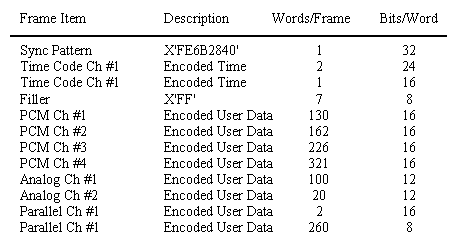
significant bit first. Table 6-13, which is an example
of an ARMOR frame with two analog, one parallel, four PCM, and one time code
channel, is referenced in the following descriptions.
6.17.3.4 Sync Pattern. All ARMOR frames
begin with the fixed 32-bit sync pattern hexadecimal FE6B2840.6.17.3.5 Time Code Channels. When time code channels are present in an ARMOR multiplex, their data words always
immediately follow the sync pattern or another time code channel. Time is
encoded as 64 bits in two 24-bit words and one 16-bit word.
Table 6-14 defines the individual bits of the time code
words. The encoded time is the time at the start of the ARMOR frame.
6.17.3.6 PCM Channels. User PCM data is
encoded into 16-bit words. The number of 16-bit words (per channel) in each
frame is approximately two percent greater than the number required to store the
user data during the frame time period. These overhead words are included to
compensate for minor variations in user data clock rates. In order to record the
number of allocated frame bits which actually contain user data, the first two
16-bit words are redundant copies of a bit count. In
Table 6-13, PCM Channel #1 has 130 words: two count words and 128 data
words. The bit count in either one of the redundant count words records the
number of bits in the 128 data words that are actually user PCM data (most
significant bit first). All remaining bits are filler. The first user data bit
in the most significant bit location of the third channel word (the first data
word following the redundant count words) was the first bit to be received after
the start of qqthe ARMOR frame.
6.17.3.7 Analog Channels. Analog data is
digitized into either 8-bit or 12-bit samples using offset binary notation (a
sample of X’00’ or X’000’ is the largest negative value). No overhead words or
bits are included with analog channel data because input sampling is synchronous
to the start of the ARMOR frame. The first sample of each channel was captured
at frame start time with all remaining samples evenly spaced throughout the frame
time. Note that the location of the analog channel words within the composite
ARMOR frame has no correlation with the time between the start and end of the
frame when the analog samples were captured (digitized). The first sample of the
100 Analog Channel #1 words and the first sample of the 20 Analog Channel #2
words in Figure 6-19 were both captured (digitized) at the same instant in time,
which was the frame start time. Voice is a special case of an analog channel in
that it is always 8-bit samples.
6.17.3.8 Parallel Channels. The encoding of
parallel input channels is very similar to PCM encoding. Approximately two
percent more than the minimum number of words necessary to store the user data
during one ARMOR frame period are allocated to each parallel channel. The first
two 16-bit words of each channel are redundant count words that record the actual
number of allocated data words that contain user data. The remaining allocated
words contain filler. Table 6-13 has two entries for
Parallel Channel #1. The first entry shows the two (redundant) 16-bit count
words and the second entry shows the number of allocated 8-bit data words for
the channel. The number of 8-bit data words that contain user data is determined
by examining either of the two count words. The first data word for each parallel
channel was the first word received after the start of the ARMOR frame.
6.17.4 ARMOR Format Compatibility.
Compatibility with the ARMOR format can be divided into two distinct cases. In
the first case, the user is playing back a legacy tape (made with legacy
multiplexer hardware and software) on non-legacy demultiplexer hardware and
software. In the second case, the user is creating a tape on non-legacy
multiplexer hardware and software for future playback by legacy demultiplexer
hardware and software.In the first case, the legacy tape contains a setup block (see Section 6.17.2 above) at the start of the recording. The setup block contains the information necessary for the user to demultiplex the data records on the tape. The bit rate field in the setup block header section specifies the rate at which the legacy recording was generated. The saved scanlist field in the setup block trailer section specifies the exact sequence and size of the sync, data, and filler words in the recording. In the second case, the user must first generate an ARMOR setup block at the start of the recording. Subsequent data records must then be formatted in accordance with the specification in the setup block. Setup Block creation is described in appendix L.
6.17.5 ARMOR Format Validation. The
CALCULEX, Inc. ARMOR Format Verification Program (AFVP) may be used to determine
if an independently generated multiplex is compatible with existing legacy
hardware. The AFVP reads the setup block (see Section 6.17.2
above) from the data set under test and validates the data set frame
structure. Please refer to IRIG 118, Vol III. The AFVP may be obtained from
CALCULEX.5Footnotes 4. Part Number 199034-0002, available from CALCULEX, Inc., P.O. Box 339, Las Cruces, NM 88004 or by email to info@calculex.com. 5. Part Number 198007-0001 may be obtained from CALCULEX, Inc. P.O. Box 339, Las Cruces, NM 88004 or by email request to info@calculex.com. |